Updated November 22, 2026. Every figure below is dated and linked to its source.
Short answer: When no one else will give you a loan in Canada, try free options first, then a credit union, then online lenders that approve on income instead of credit score. Since January 1, 2025, no lender in Canada can charge more than 35% APR, all fees included. Payday loans are the exception, at $14 per $100.
Key facts, November 2026
- Since January 1, 2025, no lender in Canada can charge more than 35% APR, all fees included, under the Criminal Interest Rate Regulations (SOR/2024-114).
- A payday loan costs up to $14 per $100 borrowed, about 365% a year, according to the Financial Consumer Agency of Canada (FCAC, 2025).
- Equifax Canada (August 2026) reports a 90-day non-mortgage delinquency rate of 1.76% in the second quarter of 2026, up from 1.70% a year earlier.
- Canadians filed 36,797 consumer insolvencies in the third quarter of 2026, up 1.5% from a year earlier, according to CAIRP (November 2026).
- Households owed $1.76 in debt for every dollar of disposable income in the second quarter of 2026, says Statistics Canada (September 2026).
Definition. A last-resort loan is a small, short-term loan, usually $300 to $1,500 in Canada, approved on your income after banks have said no.
Who will give me a loan if no one else will in Canada?
The lenders most likely to say yes when your bank says no are credit unions, online instalment lenders and loan-matching services that approve on income. Pawnshops and payday lenders will also lend, but they cost more or put your belongings at risk. Before any of them, free options like a payment plan or a pay advance can solve the problem without a loan.
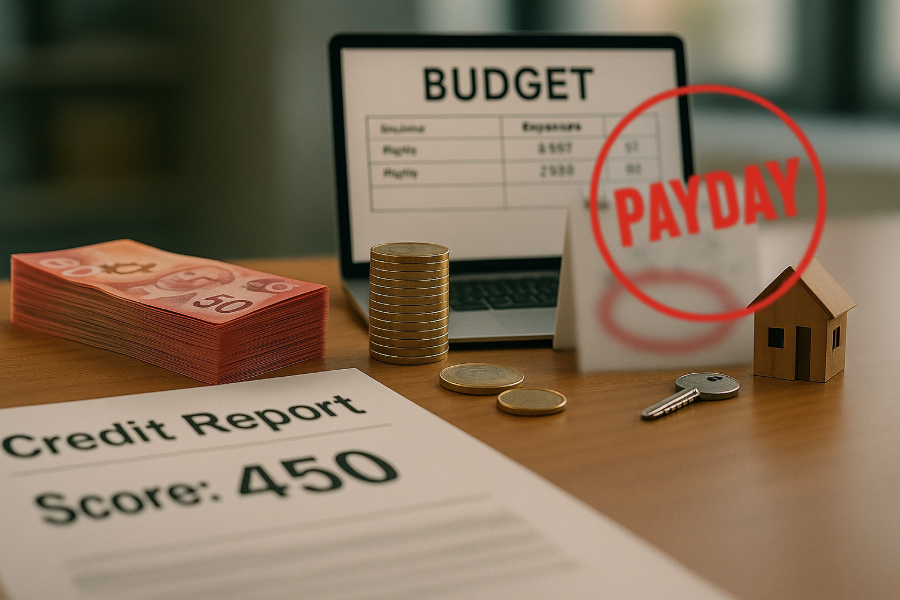
Banks mostly decide on your credit score and your debt load. Equifax Canada (2026) says scores run from 300 to 900 and calls a score below 560 poor. With a score in that range, a bank personal loan is unlikely. Smaller lenders look at other things. They check for a regular deposit into your bank account and whether a payment fits your budget.
You are not alone in hearing no. In a payday loan user survey by the FCAC (2016, updated 2025), 27% said a bank or credit union would not lend to them. Only 35% of those borrowers had a credit card, compared with 87% of Canadians overall. Being turned down by a bank is common, and it does not mean every door is closed.
Why do banks say no, and does it mean everyone will?
A bank refusal usually means your file did not fit its rules, not that no one will lend to you. Banks focus on credit score, missed payments in the last few years and how much you already owe. Our guide to bad credit loans in Canada explains how other lenders weigh the same file differently.
Missed payments stay on your file a long time. According to the FCAC (July 2026), late payments stay on your Equifax and TransUnion reports for up to 6 years. A consumer proposal is removed 3 years after you pay it off, or 6 years after signing, whichever comes first. During that time, banks often decline automatically.
Many Canadians are in the same position right now. Equifax Canada (August 2026) reports that the average consumer carried $22,699 in non-mortgage debt in the second quarter of 2026. Higher debt makes banks stricter. If your score is around 400 to 500, our post on loans with a 400, 450 or 500 credit score shows what is realistic.
Interest rates also shape how strict lenders are. The Bank of Canada (October 28, 2026) raised its policy rate by 0.25 points to 2.5%. When rates rise, banks tend to tighten lending to riskier borrowers. That pushes more people toward credit unions and online lenders.
Which options should you try first, ranked by cost?
The cheapest options are the ones that are not loans at all, so start there and move down the list only if you must. The table below ranks nine honest options from lowest to highest cost. It compares what each one costs, who decides, and the main risk, using the sources linked in this post as of November 2026.
| Option (ranked) | Typical cost | Who says yes | Main risk |
|---|---|---|---|
| 1. Ask for more time on the bill | Often free, or a late fee | The company you owe | They may refuse |
| 2. Employer pay advance | Usually free | Your employer | Smaller next paycheque |
| 3. Non-profit credit counselling | First meeting free at reputable agencies (FCAC) | Not a lender; negotiates with creditors | Plan can be cancelled if you miss payments |
| 4. Family or friends | Often no interest | Someone who knows you | Strain on the relationship |
| 5. Credit union small loan | Example: 19% fixed at Vancity (BC) | A member-owned lender | Membership and residency rules |
| 6. Bank line of credit, overdraft or cash advance | $5.92 to $7.65 on $300 for 14 days (FCAC) | Your bank, if you already qualify | Often unavailable with bad credit |
| 7. Online instalment loan | Up to 35% APR, all fees included | Lenders that weigh income | Higher cost than a bank |
| 8. Pawn loan under $1,000 | Up to 48% APR under SOR/2024-114 | A pawnshop, based on your item | You lose the item if you do not repay |
| 9. Payday loan | $14 per $100, about 365% a year (FCAC) | Payday lenders | Repeat borrowing cycle |
The first four rows cost little or nothing, so they deserve a phone call before any loan. The FCAC (2025) lists three alternatives to a payday loan: asking for more time to pay, cashing in vacation days and an employer pay advance. Utilities, phone companies and landlords often accept a short payment plan if you call before the due date.
Credit counselling is worth a call when several debts are piling up at once. According to the FCAC (2025), no reputable credit counselling agency charges you for the first meeting. Talking to a credit counsellor does not affect your credit score. A licensed insolvency trustee also offers a free first assessment if your debts are serious.
Which lenders say yes after a bank says no?
Credit unions, online instalment lenders and pawnshops are the lenders that most often say yes after a bank refusal. Each one uses a different test. Knowing that test tells you where your file has the best chance.
Credit unions. Some credit unions offer small loans built as payday alternatives. Vancity's Fair and Fast Loan lends $100 to $2,500 at 19% fixed over 1 to 2 years, says Vancity (November 2026). It is only for BC residents who become members. It also excludes people with an undischarged bankruptcy or an open consumer proposal. Ask your local credit union whether it has a similar product.
Banks, if you already have a product. If you still have a credit card or line of credit, using it can be cheaper than a new loan. The FCAC (2025) says borrowing $300 for 14 days costs $5.92 on a line of credit. It costs $7.42 with overdraft protection and $7.65 as a card cash advance. The same $300 costs $42.00 as a payday loan.
Online instalment lenders. These lenders approve small loans on your regular income and bank history. Most repay over several months, not one paycheque. Their cost is capped at 35% APR, all fees included. A loan-matching service sends one application to several of them, so one refusal is not the end.
Co-signers and co-borrowers. A second person on the loan can open doors, but they become responsible if you stop paying. Our post on bad credit loans with no guarantor explains how to borrow without one. If you live in Quebec, AvenaWise is a co-borrower loan service for Quebec residents, for amounts of $250 to $1,500.
Pawnshops. A pawn loan is secured by an item you leave with the shop. Under the Criminal Interest Rate Regulations (2024), pawn loans under $1,000 may charge up to 48% APR. If you do not repay, the shop keeps the item, and it cannot pursue you for more. At 48% a year, a $500 pawn loan costs about $20 in interest for one month.
How do you apply for a small loan after being turned down?
Apply once through a service that reaches several lenders, and only for the amount you need. Loan Boys is a Canadian loan-matching service: one short application is reviewed by several lenders, with no hard credit check and repayment over 3 to 6 months. Loan Boys is not a lender. It serves Ontario, Alberta, British Columbia, Manitoba, Saskatchewan, Nova Scotia, New Brunswick and Newfoundland and Labrador.
Approval rates are high because one application reaches several lenders, and there is no hard credit pull. You need to be 18 or older, a Canadian resident and have regular income. Decisions usually come in minutes during business hours, and approved funds arrive by Interac e-Transfer. Follow these steps to give your application its best chance.
- Write down the exact gap. List the bill, your take-home pay and your fixed costs. Borrow only the difference, not a round number.
- Check that the payment fits. Use the cost table below. If one payment would take most of a paycheque, borrow less or choose 6 months.
- Gather your documents. Have photo ID, a recent pay stub or benefit statement and your online banking login ready.
- Apply once. Start your application online. Several lenders review it, with no hard credit check.
- Read the offer before you accept. Check the APR, the total cost in dollars, the payment dates and any fees for a missed payment.
- Set up the payments. Match each payment date to your payday so the money is in your account.
What does a small loan cost at 35% APR?
At the legal maximum of 35% APR, a $500 loan repaid over 3 months costs $29.44 in interest. The table below compares the monthly payment and total cost of borrowing for $500, $1,000 and $1,500 over 3 and 6 months. It was calculated by Loan Boys on November 22, 2026, assuming 35% APR compounded monthly, equal monthly payments and no other fees.
| Amount borrowed | Term | Monthly payment | Total cost of borrowing |
|---|---|---|---|
| $500 | 3 months | $176.48 | $29.44 |
| $500 | 6 months | $92.04 | $52.24 |
| $1,000 | 3 months | $352.96 | $58.88 |
| $1,000 | 6 months | $184.09 | $104.54 |
| $1,500 | 3 months | $529.45 | $88.35 |
| $1,500 | 6 months | $276.13 | $156.78 |
Compare that with a payday loan. At $14 per $100, a $500 payday loan costs $70 for a single pay period of about two weeks. That is more than twice the $29.44 cost of a $500 loan spread over 3 months at 35% APR. The payday loan is also due in one lump sum, which is why many borrowers take a second one.
A longer term lowers each payment but raises the total cost. Over 6 months, a $1,000 loan costs $104.54 instead of $58.88 over 3 months. Pick the shortest term whose payment you can make without missing rent or groceries.
What mistakes and scams should you avoid?
The biggest mistake when you are desperate is paying someone before you receive a loan. The Canadian Anti-Fraud Centre (2026) says that in most provinces, asking for an upfront fee before a loan is illegal. It also warns against lenders that guarantee approval regardless of credit. Stop all contact if someone asks for payment by e-Transfer, gift card or prepaid card.
Do not apply to ten lenders one by one. Each hard inquiry stays on your file. According to the FCAC (July 2026), hard inquiries stay 3 years at Equifax and 6 years at TransUnion. Use services that do not run a hard credit check when you are only comparing offers.
Know your payday loan rights if you do use one. In Ontario, a payday loan cannot exceed 50% of your net pay, according to the Government of Ontario (2025). The fee for a dishonoured payment is capped at $20. You can cancel within two business days without giving a reason. Lenders must offer an extended payment plan if you take three loans within 63 days.
Other provinces set their own limits. In Manitoba and New Brunswick, a payday loan cannot exceed 30% of your net pay. In Alberta, you get at least 42 days and two instalments to repay a payday loan. In British Columbia, a payday lender cannot lend you money to repay another payday loan. Check your provincial consumer protection office before you sign anything.
What should you do next so you are not turned down again?
The way out of last-resort borrowing is a credit file that shows recent on-time payments. Every small loan you repay on schedule helps, but you also need tools built for rebuilding. Start while you are repaying, not after.
A secured credit card is the classic first step. You put down a deposit, and the card company reports your payments to the credit bureaus. A credit-building membership such as AvenaCredit reports a monthly tradeline to Equifax Canada, which adds a steady payment history. Keep your card balance well below the limit and pay every bill on time.
Watch how your file changes. Late payments fade from your report after up to 6 years, according to the FCAC (July 2026), and their weight drops well before that. Check your Equifax Canada and TransUnion Canada reports once a year and dispute any errors. Then build a small emergency fund, even $25 a paycheque, so the next surprise bill does not need a loan.
Related questions
Can a credit union lend to me if my bank said no?
Yes, often. Credit unions set their own rules, and some offer small loans built as payday alternatives. Vancity in BC, for example, lends $100 to $2,500 at 19% fixed to members who qualify.
Can I get a loan with no credit history at all?
Yes. Lenders that approve on income can lend with a thin file. A secured card or credit-building product will then start your credit history.
Is it a bad sign if every lender turns me down?
It can be. If you cannot afford one more payment, talk to a non-profit credit counsellor. The first meeting at a reputable agency is free, according to the FCAC.
Can I get a loan on benefits like ODSP or EI?
Some lenders accept government benefits as regular income. Bring your latest benefit statement and bank statements showing the deposits.
Sources
- Canada Gazette: Criminal Interest Rate Regulations, SOR/2024-114 (2024)
- FCAC: Payday loans (October 2025)
- FCAC: Payday loans, market trends (2016 survey, updated September 2025)
- FCAC: How long information stays on your credit report (July 2026)
- FCAC: Getting help from a credit counsellor (October 2025)
- Equifax Canada: What is a good credit score? (2026)
- Equifax Canada: Q2 2026 Market Pulse (August 2026)
- CAIRP: Q3 2026 consumer insolvencies (November 2026)
- Statistics Canada, The Daily: National balance sheet, Q2 2026 (September 2026)
- Bank of Canada: rate announcement (October 28, 2026)
- Vancity: Fair and Fast Loan (November 2026)
- Canadian Anti-Fraud Centre: Loan scams (January 2026)
- Government of Ontario: Payday loans, your rights
About the author
LoanBoys Editorial Team
Personal finance writers, Loan Boys
Every figure in this guide is checked against its primary source and dated. Drafts are prepared with AI assistance and edited by a person before publication.